
Torticollis in Babies
Reviewed by Dr. Matthew Roller, D.C., CACCP — Updated August 2026
Do you notice your baby’s head tilting or turning to one side?
It could be torticollis — Torticollis is a common but treatable condition in newborns and infants. Gentle chiropractic care can help your baby move freely, comfortably, and happily.
How to tell if it might be torticollis
- Head consistently tilted to one side
- Head turned to one side, or tilted and turned together
- A clear preference for looking one way, and resistance turning the other
- Difficulty feeding on one side
- A flattening starting to appear on one side of the head
When you are most likely to notice it: many cases are subtle at first — a slight tilt or mild side preference is easy to miss in a newborn who sleeps most of the day. It usually becomes clearer at 6 to 12 weeks, as babies get more alert and active and the pattern starts to stand out.
What to expect:
- Brief health history with the Doc
- Head to toe musculoskeletal initial exam
- After care expectations
Your baby is adjusted on the first visit. There is no second appointment booked just to come back and be given a plan and a price.
Why it is worth acting early. Left untreated, the head turning every time they lie on their back can lead to a flat spot on their head, which then can lead to needing a costly helmet they have to wear all day and night.
The sooner we address the issue, the better quality of life your baby will have!
What parents often notice after:
- A blowout, as the digestive system settles
- Sleeping for a long stretch
- More relaxed in your arms
As the body processes the new input and the brain gets clearer information, things start working the way they should.
Why it happens
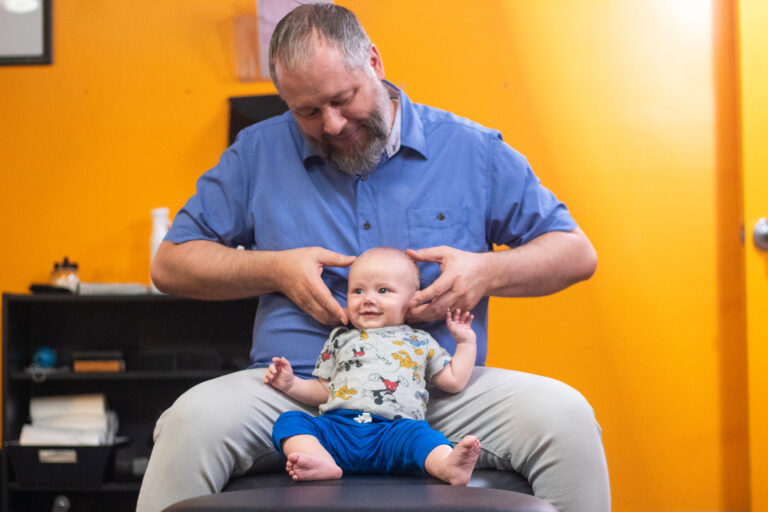
Torticollis has more than one cause. It can develop from how a baby was positioned in the womb, or from difficulties during birth.
At the very top of the spine sits the first cervical vertebra, known as the atlas. When the atlas is properly aligned, the head moves freely and evenly in both directions. When it is misaligned or restricted — even slightly — it can dramatically limit how far baby can turn their head to one side. It can irritate the nervous system causing a muscle in the front of the neck to fire that causes the head turning and tilting.
What the research shows
Torticollis showed up in more than half of the 145 infants studied
A 2026 retrospective analysis of 145 infants under chiropractic care found torticollis among the most common reasons babies were brought in, alongside feeding difficulty and restricted neck movement. The most common exam findings were tight neck muscles, joint tenderness, and a head tilt or turn — exactly what Dr. Roller checks at a first visit.
View source
Dorough A, Alcantara J. Birth Trauma, Vertebral Subluxation, Feeding Dysfunction & Early Infant Health Challenges: A Retrospective Analysis of 145 Infants Under Chiropractic Care. Journal of Pediatric, Maternal & Family Health Chiropractic, 2026.
The signs often followed a harder birth
The same study found these signs frequently came after long labours, extended pushing, or an epidural. That matches what we see clinically: torticollis is usually connected to how a baby was positioned or how much stress the neck was under during delivery — not something that just happens at random.
A retrospective analysis describes what was found in this group of babies. It does not predict what will happen for every baby.
